
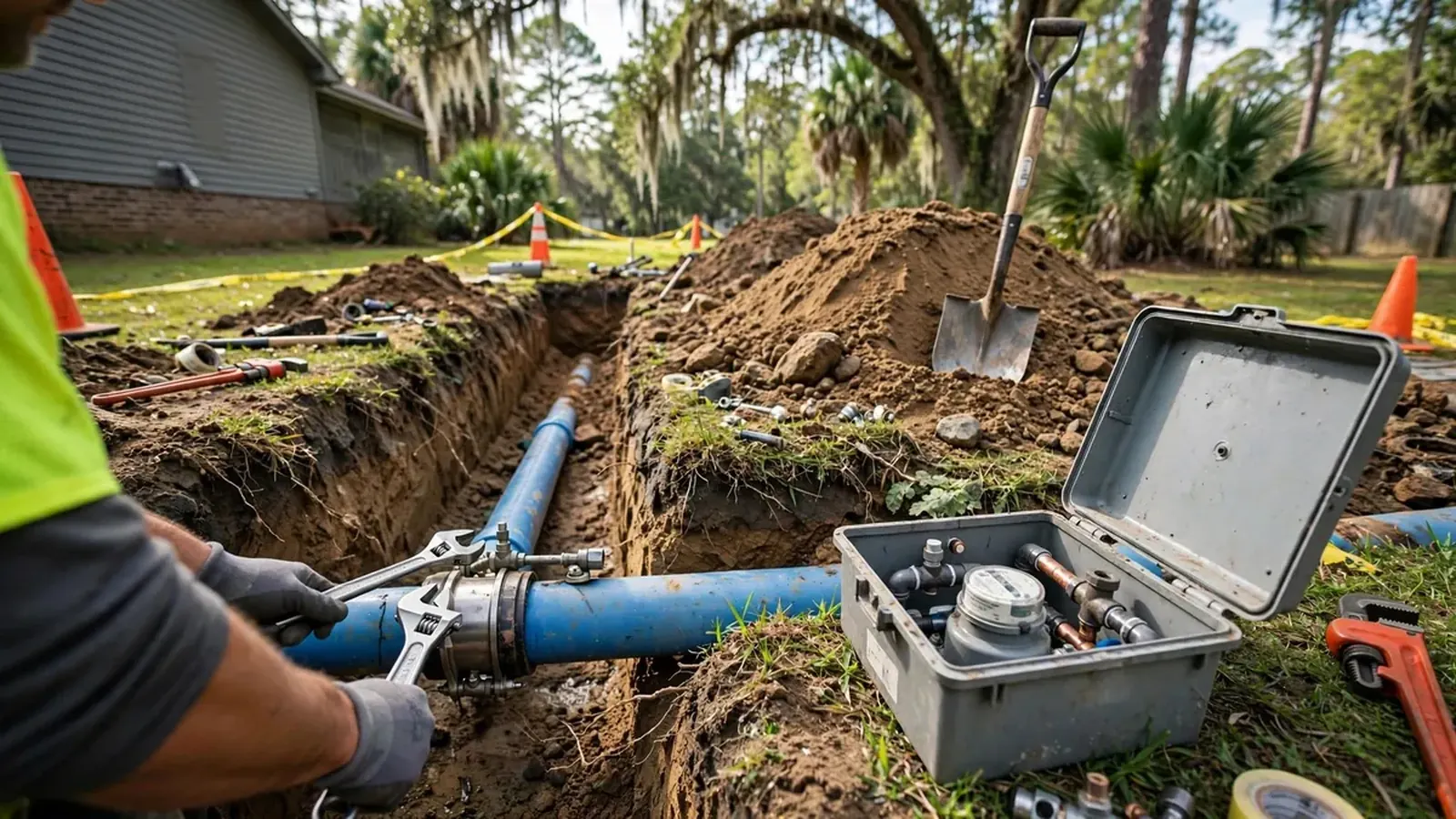
Pressure dropped and the yard is wet
A soft patch of lawn, a basement wall that is damp where the line enters, or a faucet that sputters can all trace back to a leak in the service line. Those symptoms are what homeowners usually describe, and the cure is a locate and a repair, not a bigger pump or a new faucet.
When a water line leak is an emergency
Call right away when water is entering the basement, when the yard is flooding, when the whole house has lost pressure, or when the meter will not stop with the main valve open. The line is open 24/7, and we offer same-day appointments when available for leaks that are contained once the main is shut.
- Close the main valve inside the house and see if the meter stops
- Move anything valuable off a wet basement floor
- Keep children and pets away from standing water near electrical panels
- Do not dig or probe the soil, since you could damage the line or other utilities
- Call the 24/7 line and describe where the water is showing
Service line leaks and where they start
The service line runs from the water main to the house. It crosses soil that freezes, shifts and settles, and over time that stress finds weak points at the fittings, at the point where the line enters the foundation and at old repairs. In houses with older metal lines, corrosion thins the pipe from the inside.
We start with the meter and the main valve to confirm the leak is on the line itself. Then a ground microphone and a pressure test narrow the location. Our leak detection tools let us confirm before anyone digs.
| Sign | What it suggests | Next step |
|---|---|---|
| Wet or sunken ground in a straight line | Leak along the buried path | Locate with listening gear and mark the spot |
| Meter runs with house valve closed | Leak between meter and valve | Pressure test the line |
| Water at the foundation wall | Leak at the entry point | Inspect the entry fitting and seal |
| Weak flow at every tap | Leak, partial blockage or a failing valve | Check pressure and the main valve |
| Hissing near the meter | Fitting leak or a pressure issue | Shut the main and inspect the connection |
Ask Woodridge Public Works where the Village's responsibility ends, since the answer sets who repairs which section.
Buried line repair and how we get to it
Once the leak is located, you have a choice. A spot repair works when the line is sound except for one failed fitting or one short length. Replacement makes sense when the line is corroded along its length or has been repaired several times.
Digging needs the utilities marked first. JULIE provides that locating, and the 811 call is made at least three days ahead. If you ever smell gas, leave first and call Nicor on 888-642-6748. We restore the trench as agreed and tell you what the repair covered.
Low water pressure and what causes it
Low pressure is not always a leak. A partly closed main valve, a failing pressure regulator, a clogged aerator or an old galvanized line choked with scale can all do it. A leak on the service line usually shows up as a house-wide drop, along with the signs outside.
We measure pressure at an outdoor faucet, then at a few fixtures inside, to see whether the problem is in the line, the house plumbing or one fixture. If one tap is weak and the rest are fine, the issue is local, and a faucet repair may be the whole answer. If every tap is weak, the main valve, regulator or line itself is next.
Lead service lines in Woodridge
The Village inventory lists 10,002 water service lines connected to its system, and as of April 2026 it has not found any lead service lines. Illinois law, the Lead Service Line Replacement and Notification Act, says that when a lead line is repaired or upgraded, the whole lead line must be replaced, and partial replacements are no longer permitted. In practice, if a repair ever exposes a lead line, the plan changes from a patch to a full replacement.
Read the Village's lead service line page for the latest inventory. We do not test water for lead or diagnose health effects.
Water mains, Public Works and your side of the line
If you see water bubbling up from the street or a parkway, that is a main problem and not your service line. Call Woodridge Public Works at 630-719-4753 during business hours. After hours and on weekends, the Village says to dial 911 so a crew is dispatched. A Public Works employee is on call around the clock.
For anything between the street and your house, ask Public Works where the Village's responsibility ends before you pay for a repair. We also repair lines for homeowners in nearby Darien. Failures inside the house belong under burst pipe repair.
What affects the cost of a water line repair
No two service lines are alike, so a single number would mislead you. You get a clear price before work starts, after the leak is located.
Insurance policies differ. Some cover a sudden service line failure, and many exclude wear, corrosion or underground lines unless you added an endorsement. Read your policy or ask your agent before you commit to a repair.
Replacing a service line is permit work, and state law rules out partial lead line replacement. The Village of Woodridge has adopted the Illinois State Plumbing Code, and permitted work is inspected against that standard.
Questions we hear
Yes. The line is open 24/7. Close the main valve inside the house, keep people away from wet electrical areas, and call with a description of where the water is showing.
Water bubbling from the street or parkway usually points to the Village main. Call Woodridge Public Works. A wet yard between the curb and your foundation points to your service line.
A leak on the service line, a stuck pressure regulator or a partly closed main valve can all cause it. We check the pressure at an outdoor tap first to see where the loss starts.
Yes, when the line is corroded, repeatedly repaired or leaking in several places. We explain the route, the restoration and what the Village requires before the work starts.
The Village reports that as of April 2026 its inventory has not found any lead service lines. If a repair ever exposes one, state law requires replacing the whole line.
Yes. Calls to 811 or 800-892-0123 locate buried utilities, and they should be made at least three days before digging. We tell you when the locate is needed for the job.
If you are not sure whether the leak is outside or inside, a leak detection visit separates the two before any digging.