
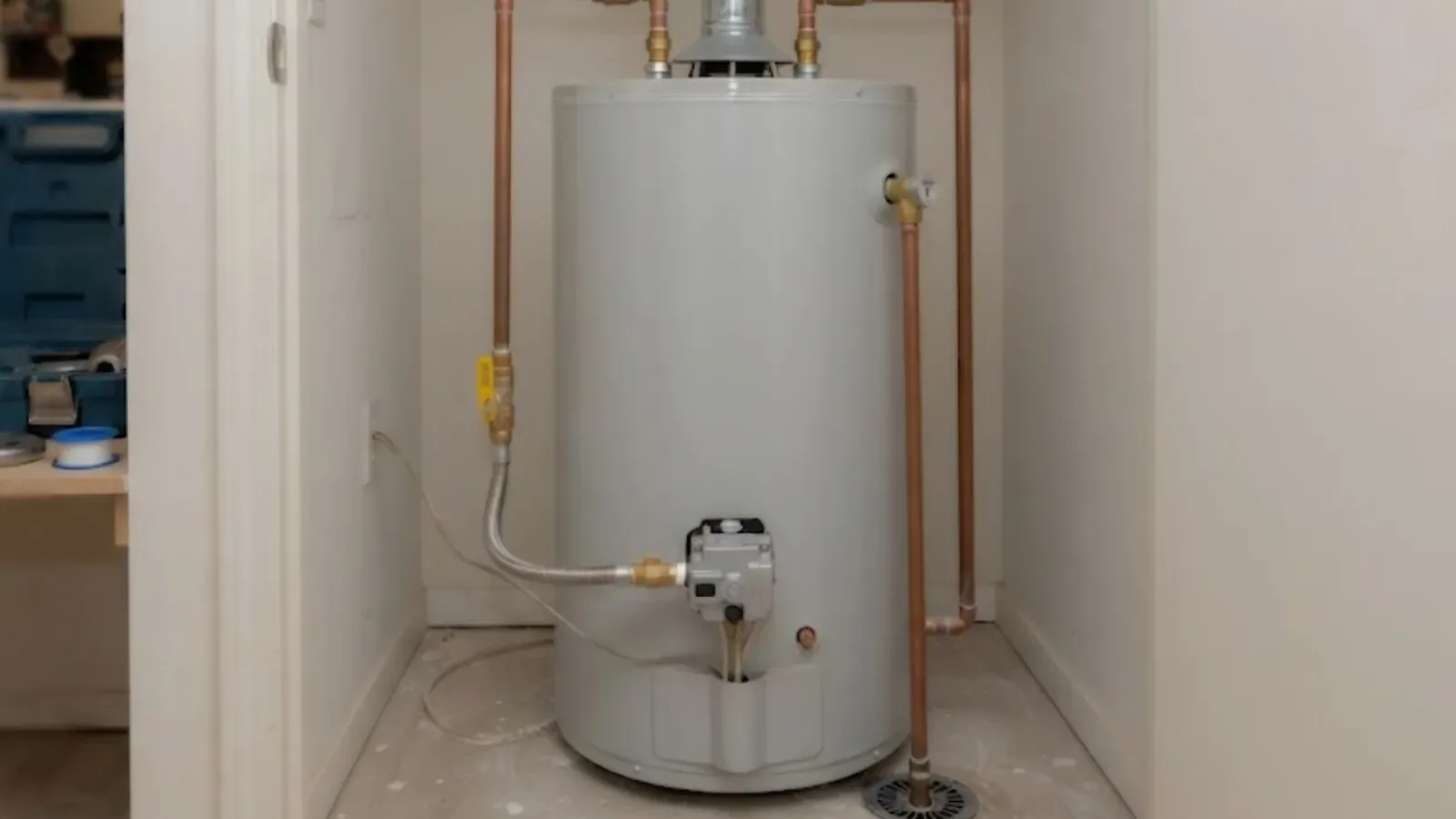
Start with how your household uses hot water
The right heater depends on people, not square footage. Count the showers that overlap in the morning, the laundry loads and whether a soaking tub fills in one go. Those habits set the tank size or the flow rate you need.
| Your situation | Option to consider | Why |
|---|---|---|
| Household of one or two, light use | Smaller standard tank | Lower up-front cost and less standby loss |
| Family with overlapping showers | Larger tank or high-recovery unit | More hot water ready at once |
| Tight utility closet | Tankless or a low-profile tank | Saves floor space |
| Gas line already present | Gas tank or gas tankless | Uses existing supply, needs venting check |
| No gas and a panel with room | Electric tank, or a hybrid heat pump unit | Needs a dedicated circuit |
We confirm sizing on site. A phone description is a starting point, not a final answer.
Fuel changes and moving the heater
Swapping like for like is the simplest install. Changing fuel or relocating the heater is a larger job. Gas to electric needs a circuit and panel capacity. Electric to gas needs a gas line, a combustion air plan and a flue.
Moving a heater from a cramped closet to an open basement wall can make later service easier. It also means new supply and drain runs. If other piping work is part of the project, our plumbing installation service covers the related fixtures and lines.
If you smell gas
Leave the house first and move a safe distance away. Then call Nicor Gas on 888-642-6748 or 911 before you call a plumber. Do not flip switches or relight a pilot.
The install day, step by step
- Walk the space, confirm the model, fuel and venting path
- Shut off water and power or gas, then drain the old tank if there is one
- Set the new heater on a level pad with a pan where the space needs one
- Connect supply lines with new connectors and a working shutoff on the cold side
- Install the temperature and pressure relief valve with a proper discharge pipe
- Connect gas or electric, then check venting and test for leaks
- Fill, purge, power up and set the temperature
- Schedule the Village final inspection
Expect the work to take part of a day for a standard swap and longer for a conversion. We agree on the scope before we start.
Permit and inspection in Woodridge
Woodridge requires a permit and a final inspection for a water heater, and it treats all plumbing work as permit work. The permit comes from the Community Development Department at 5 Plaza Drive, 630-719-4750. The Village's permit FAQ spells it out.
An inspected install protects you when you sell the house or file an insurance claim. The Village also adopted the Illinois State Plumbing Code, and the contractor must be licensed. You can check any plumber on the IDPH license lookup.
What older Woodridge homes bring to an install
The median Woodridge home dates to 1980, and about 69 percent were built before 1990. In houses like that, a new heater often meets old gas pipe, original shutoffs or a flue that was sized for a different appliance. We inspect these before we connect anything.
Basement installs also depend on drainage. The relief valve discharge has to end somewhere safe, and a floor drain nearby makes that easier. If your basement has no drain or you have had backups, tell us.
Winter conditions matter for garage and exterior-wall locations. Average January lows are about 19 degrees at the nearest weather station, so exposed pipes need insulation or a move.
Clear the area before we arrive
- Move boxes and shelves away from the old heater
- Know where your main water shutoff is
- Clear a walkway from the door to the heater
- Tell us about any past leaks or smells near the unit
- Plan to be without hot water for part of the day
If you are not sure whether a tank is worth keeping, a repair visit can answer that before you commit to a new unit.
What shapes the cost of a planned install
Because you choose the unit and the schedule, the price depends on those choices. You get a clear price before work starts.
Insurance usually does not cover a planned upgrade. Policies differ, so ask your agent if you are replacing a failed unit after damage.
A new install is permit work in Woodridge, with a final inspection. The Village of Woodridge has adopted the Illinois State Plumbing Code, and permitted work is inspected against that standard.
Questions we hear
A standard like-for-like swap takes part of a day. Fuel changes, venting work or relocation take longer. We give you the scope before we begin.
Yes, if the space, gas line and venting support it. See the details on our tankless water heater page.
Yes. The Village requires a permit and a final inspection for a water heater.
Often. It means new supply, drain and possibly venting runs. We look at the new location before agreeing to the plan.
It depends on where the heater sits. A heater above finished space usually needs one, with the discharge routed safely.
Woodridge requires a permit and an inspection, and gas and venting mistakes are dangerous. We recommend a licensed plumber.
Yes. Builders, owners and associations can ask about single units or several. Tell us the building layout when you call. We also schedule installs in nearby Darien.
If your current heater has already failed, our emergency replacement service moves faster than a planned install.