
My water bill jumped and nothing is dripping
A bill that climbs for no reason is one of the most common ways a hidden leak announces itself. Water can run inside a wall, under a floor or along a buried line for weeks without leaving a puddle. Finding it takes testing, and that is what leak detection means in practice.
Reading your meter to confirm a leak
You can learn a lot before anyone arrives. The meter counts every gallon entering the house, so if it moves while nothing is running, water is going somewhere.
- Turn off every faucet and appliance, and make sure no one flushes a toilet.
- Find the meter, usually in the basement where the line enters.
- Look for the small low-flow indicator, a dial or triangle that spins at even a trickle.
- Write down the reading, wait an hour, and check again.
Then shut the main valve and look once more. If the meter stops, the leak is inside your property. If it keeps moving, ask Public Works where the Village's responsibility ends. A silent toilet flapper is the most common false alarm, and we check it first.
When a hidden leak is an emergency
Treat it as urgent if water comes through a ceiling near a light fixture, the floor feels warm or spongy, the meter is racing, or water collects near the furnace, panel or outlets. Close the main valve, keep children and pets out, and call. After-hours and weekend calls get the same careful search as any other.
Where the water is hiding, symptom by symptom
Different leaks leave different clues. This table is how we read them on the phone before we ever pick up a tool.
| What you notice | Likely source | How we confirm it |
|---|---|---|
| Meter turns with everything off | Supply line, toilet or buried service line | Isolate sections with valves and run a pressure test |
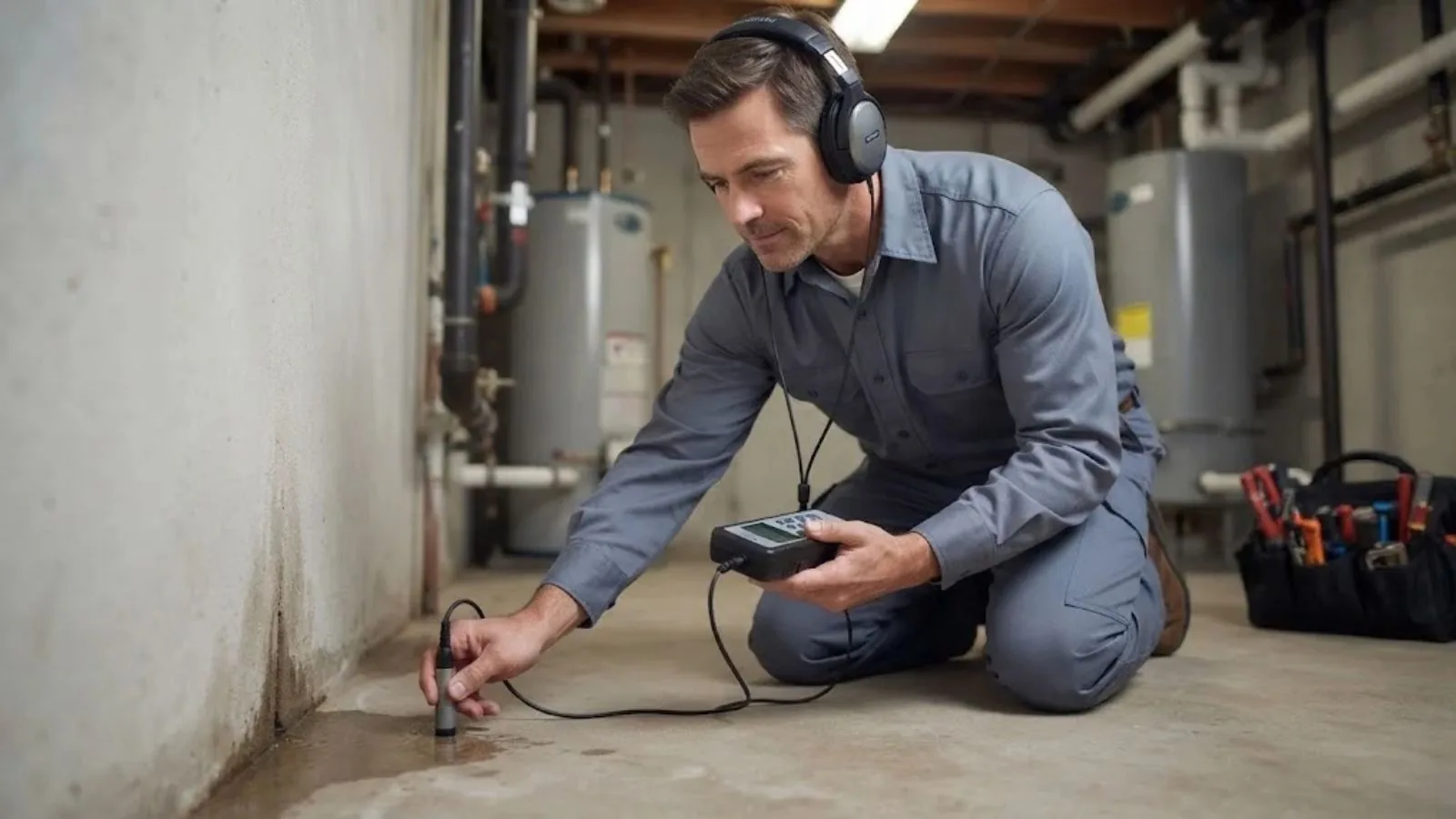
| Warm spot or hot floor | Hot water line under a slab | Thermal camera and acoustic listening |
| Brown ring on a ceiling | Supply or drain line above, or a fixture seal | Moisture meter, then trace the line upstairs |
| Musty smell, no visible water | Slow leak inside a wall cavity | Moisture readings across the wall |
| Soft or wet ground in the yard | Buried service line | Ground microphone and line pressure test |
| Low pressure with a high bill | Leak after the meter | Meter test, then isolate by zone |
A symptom points us to the right test. It is the test, not the symptom, that tells us where to open.
Slab leaks and warm spots in the floor
If your home, garage or an addition sits on a concrete slab, supply lines can run beneath it. A pinhole in a hot line shows up as a floor that feels warm, a water heater that never stops running, or carpet that stays damp. Flooring can lift and baseboards can swell long before water reaches the surface.
We listen along the floor with acoustic gear, mark the loudest spot, and confirm with a thermal camera and a pressure test. Then you choose. We can reroute the line through walls or attic, or open the slab at the exact spot.
- Shut off the main and the water heater supply if the floor is warm
- Do not run the dishwasher or washer until the leak is found
- Photograph cracked flooring or damp baseboards
Ceiling stains and wet walls
A ceiling stain is the end of a trail, not the start. Water travels along joists and pipes before it drips, so the wet spot is often several feet from the leak above.
We scan with a moisture meter, trace the pattern toward the likely supply or drain line, and use a thermal camera to separate old stains from active moisture. A damp, growing stain is active. If water is bulging the drywall, call before the bulge breaks.
Crawlspace and under-floor leaks
Homes with a crawlspace or unfinished area under part of the floor give leaks room to hide. Look for dripping insulation, rusty hangers, damp soil, a musty smell or floors that sag.
We inspect supply and drain runs from below, check for condensation that is not a leak at all, and pressure test the lines. Because we can often reach the pipe directly, these repairs tend to be simpler than walls or slabs. If the drain line rather than the supply line is leaking, a camera inspection helps, and our sewer line repair team can handle what it finds.
Buried line leaks between the street and the house
The water line that crosses your yard is out of sight, so leaks there announce themselves as a soggy patch, grass that stays green during dry weather, a sudden drop in pressure or a meter that never rests. In winter you may see a patch of ice that never melts.
We narrow the location with a ground microphone and a pressure test, then confirm before digging. Anywhere we dig needs the utilities marked first. JULIE locates buried lines, and the 811 call should go in at least three days ahead of planned digging. Once the leak is located, the fix belongs to our water line repair work.
Sprinklers, outdoor spigots and meter boxes
Outdoor leaks get overlooked because they seem harmless. A sprinkler zone with a cracked head or a failed valve can run for days. A hose bib can drip inside the wall behind it. We test the irrigation supply line and the backflow connection, and we check the meter box for seepage around the fittings.
Pool and spa shells are a different specialty. We test the house plumbing that feeds them, not the pool itself. If the leak is near the meter in your yard, call before you dig, since a shovel can turn a drip into a broken line.
After we find it, what repair looks like
Finding the leak is half the job. We explain what failed, show you where, and give a clear price before work starts. Most repairs are a section replaced with new pipe or a fitting redone. We also offer same-day appointments when available, so a confirmed leak does not have to sit overnight.
If a pipe has split open rather than pinholed, the job is closer to burst pipe repair. When we find pinholes in several places, that tells us the whole run is wearing out, and a conversation about repiping is more honest than a string of patches.
What Woodridge homes tell us about hidden leaks
The median Woodridge home was built in 1980, and roughly seven in ten were built before 1990. Supply lines, shutoff valves and fixture connections in houses that age have been under pressure for decades. When one weak joint starts weeping, others are often close behind, so we look at the whole run instead of one spot.
The water arrives from the Village, which buys treated Lake Michigan water through the DuPage Water Commission. If you see water bubbling from the ground in the street or at the curb, that is a main issue, not a plumbing one inside your walls. Call Woodridge Public Works at 630-719-4753 during business hours. After hours, the Village says to dial 911 and a crew is dispatched. You can find the Village's water information on its Public Works water page.
Cold matters too. January lows near 19 degrees at the nearest weather station mean exposed hose bibs and attic or garage lines can split, and the leak may only show during a thaw. We also take leak calls in nearby Lisle, so tell us when yours started.
What changes the cost of finding a leak
Leak work varies too much for one number. You get a clear price before work starts, based on what the first tests show.
Insurance policies differ. Many treat sudden water damage differently from wear and slow leaks, and some exclude damage under a slab or from long-term seepage. Read your policy or ask your agent first, and keep the photos and the plumber's findings with your claim.
Finding the leak needs no permit, but opening a wall or slab to fix it usually does. The Village of Woodridge has adopted the Illinois State Plumbing Code, and permitted work is inspected against that standard.
Questions we hear
Yes. The line is open 24/7 and we take overnight, weekend and holiday calls for active leaks. Tell us where the water is and whether it is near electrical equipment, and close the main valve while you wait.
Shut off every fixture and watch your meter for an hour. If it moves, there is a leak somewhere. Call and we will isolate the line or fixture responsible.
Usually, yes. Acoustic listening, moisture readings and thermal imaging locate most leaks without opening anything. Any opening is limited to a small area directly over the source.
Close the main valve inside the house and check the meter. If it stops, the leak is inside your plumbing. If it keeps running, the problem is outside your valve, and Woodridge Public Works can tell you where the Village's responsibility ends.
Yes. We start by testing the original line, since a second leak or a missed fitting is a common reason the water keeps showing up. Share what the earlier repair covered.
Yes. We identify which part of the system is leaking, so the repair goes to the responsible party. Photos and the unit location speed that up.
If testing shows a pipe has split rather than seeped, our burst pipe repair service handles the cut-out and replacement.