
Run the meter test before you call anyone
This test tells you whether the leak exists and roughly which side of the house it is on. It takes about as long as making coffee, and it gives the plumber a useful starting point.
- Stop all water use. Turn off the dishwasher, washer and ice maker, and make sure nobody flushes a toilet.
- Look at the meter. Most have a small triangle or dial that moves when any water passes through.
- If it moves, close the main shutoff valve where the line enters the house and look again.
- If the meter stops, the leak is inside the house. If it keeps moving with the main closed, the leak is on the pipe between the meter and the valve.
- Write down the meter reading, wait an hour with no water use, and check it again.
A reading that has climbed with every tap closed is the clearest evidence you can hand to a plumber. A toilet flapper that leaks into the bowl will also move the meter, so check the toilets with a few drops of food coloring in each tank before you decide the leak is in a wall.
Signs a supply line is leaking behind the scenes
Hidden leaks rarely announce themselves. They show up as small changes you can match to a place in the house.
| What you notice | Where the leak may be | How we confirm it |
|---|---|---|
| Water bill climbs with no change in habits | Anywhere on the supply side, often a toilet or an underground line | Meter test, then isolate each branch |
| Hissing or running sound with taps off | Pressurized pipe in a wall or ceiling | Acoustic listening on walls and valves |
| Warm spot on a slab floor | Hot water line under the concrete | Thermal camera and pressure test of the hot side |
| Damp patch in the lawn or a soft spot in the yard | Service line between the meter and the house | Pressure test, then ground listening |
| Low water pressure at every fixture | Main line leak or a failing valve | Pressure gauge reading and a valve check |
| Musty smell or peeling paint near an interior wall | Slow pinhole leak in a branch pipe | Moisture meter mapping |
Several of these signs can also come from a drain or roof problem, which is why we test the supply system before opening anything.
How a plumber finds the leak without tearing out walls
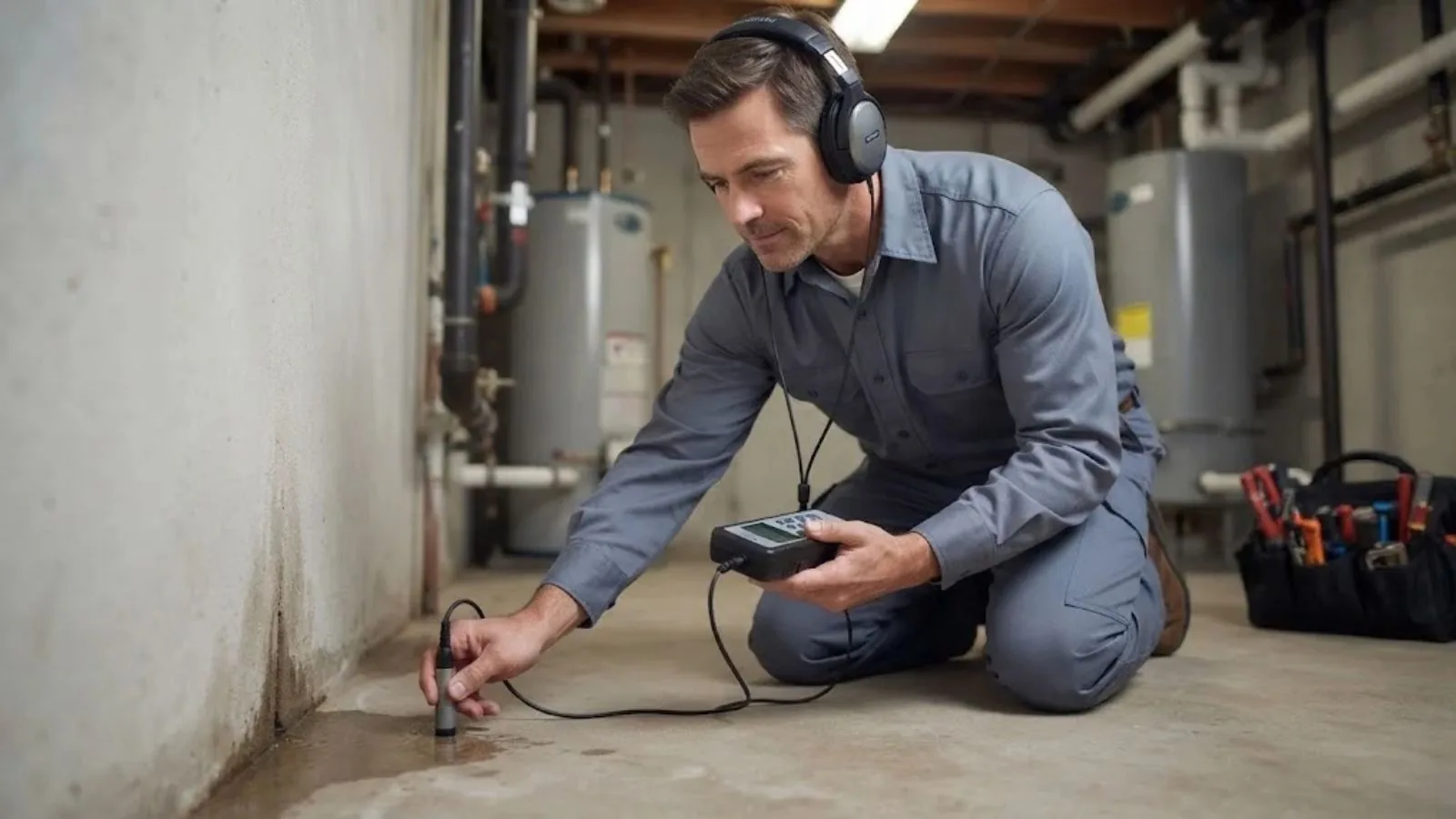
Good detection narrows the search so the repair is small. No single tool does everything, and a careful job uses more than one to agree on the same spot.
Acoustic listening
A sensitive microphone on pipes and floors picks up the sound water makes as it escapes under pressure.
Pressure testing
We isolate a section, pressurize it and watch the gauge. A falling needle means the section leaks.
Thermal imaging
A thermal camera shows temperature differences from hot water lines or wet materials, which helps on slabs.
Moisture mapping
A moisture meter traces how far dampness has spread so the opening in a wall can be as small as possible.
Once the spot is marked, the fix depends on the pipe. A pinhole in an accessible copper line is a short repair. A failed buried line may call for water line repair, and a section that keeps failing may need a bigger decision about the whole run.
When a leak is an emergency
Close the main shutoff valve if water is flowing into a ceiling, a wall or a finished basement. Keep everyone away from wet areas around outlets, panels and appliances, and do not step into standing water near electrical equipment.
If you see water bubbling up from the ground in the street or along the curb, that may be a water main. The Village asks you to call Woodridge Public Works at 630-719-4753 during business hours. After hours and on weekends, dial 911 and a crew is dispatched.
What to know about leaks in Woodridge
Village Public Works buys treated Lake Michigan water through the DuPage Water Commission and delivers it to almost 9,500 residential and business customers. That means the pressure and quality in your pipes start outside your control. Ask the Village for its annual water quality report, and test your tap if the taste or look of the water has changed.
Census-based housing estimates put the median Woodridge home at 1980, and about seven in ten were built before 1990. Original supply lines, shutoff valves and fittings at that age are the usual suspects when a leak appears, so a leak in one spot is a good reason to look at the condition of the rest.
The Village inventory lists 10,002 water service lines and, as of April 2026, has found no lead service lines. State law says that if a lead line is ever repaired, the whole line must be replaced. That rule matters only if a dig exposes one, and we would tell you before work continued.
Water service differs just over the border. In Lisle, Illinois American Water serves the Oakview area while the Village serves the rest, and Darien says its residents are not all on the same system. If you live near those lines, confirm your utility before you call about a main.
Questions to settle before the repair starts
Ask where the leak is, how it was confirmed, and how much of the wall, floor or yard needs to open. A clear answer to those three questions should come with a clear price before work starts. If a plumber cannot say how the leak was located, you are paying for a guess.
Ask whether the same line is likely to fail again nearby. Pinholes often come in clusters on aged copper. Read your homeowner policy as well, because coverage for sudden water damage often differs from coverage for slow leaks.
Our leak detection visits end with a plain explanation of what we found, where, and what your options are, including leaving a small leak alone if it is not causing damage.
Need a plumber while you read?
Our line is open around the clock, and dispatch can book a visit for the same day when a technician is free.
Questions we hear
The meter test is the quickest check. With all water off, a moving leak indicator means water is escaping. A bill that rises with no change in use, a hissing sound, or a warm patch on the floor point the same way.
Usually yes. Listening gear, a thermal camera and a moisture meter narrow the leak to a small area, so the opening is limited to that spot.
Call Woodridge Public Works at 630-719-4753 during business hours. After hours and on weekends, dial 911 and the Village dispatches a crew. A Public Works employee is on call around the clock.
It is, and it is one of the most common causes of a high bill. A worn flapper lets tank water slip into the bowl. Food coloring in the tank will show it within minutes.
We can narrow the location with a pressure test, thermal imaging and listening equipment. Whether the repair means opening the slab or rerouting the line depends on the pipe and the layout.
Policies differ. Many treat sudden damage differently from slow, long-term leaks, so read your policy or ask your agent before you file.
If the meter test says water is leaving the system, call us for leak detection and tell us what the meter did.