
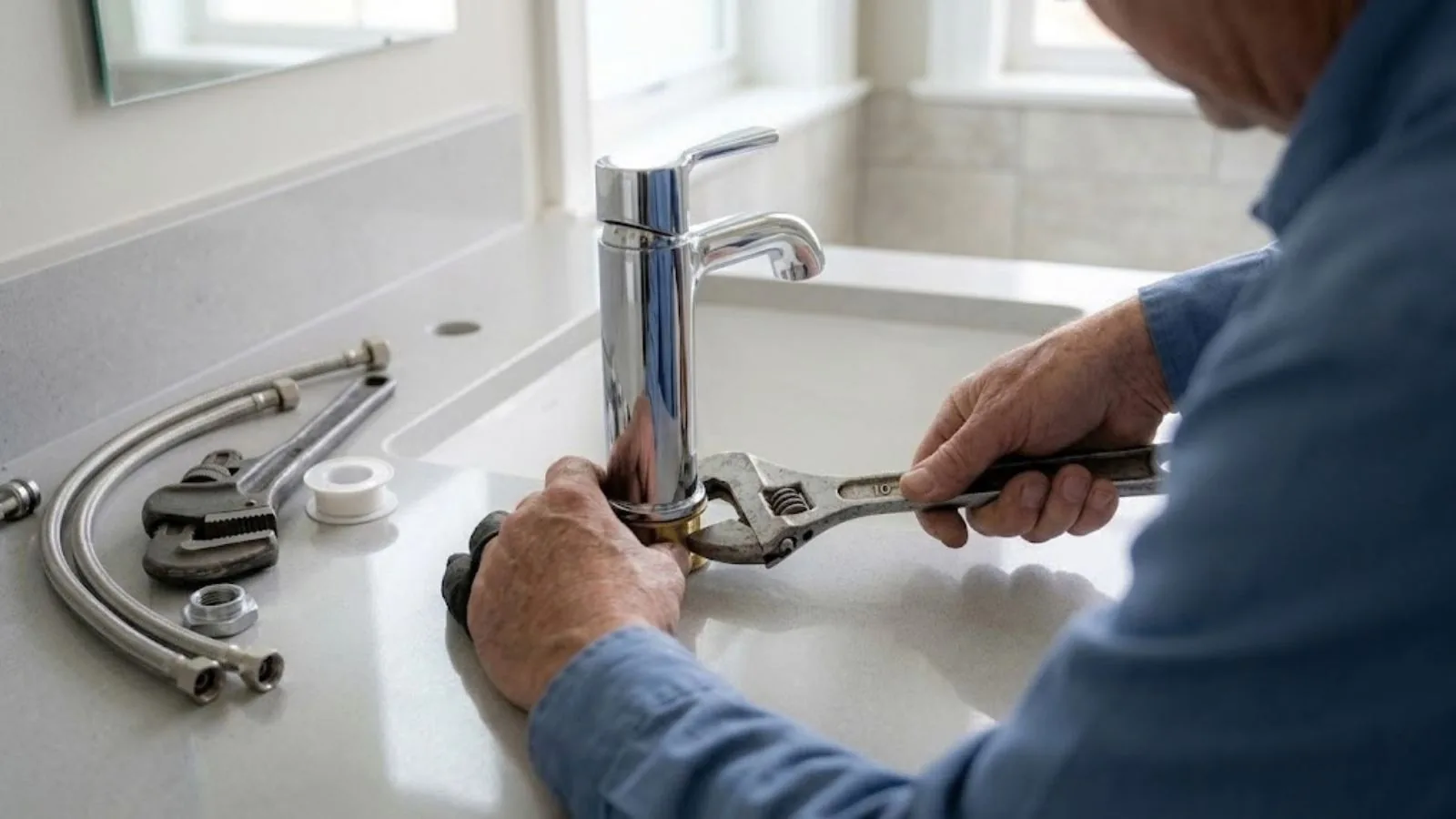
Where is the water coming from
Hold a dry paper towel against each part of the faucet while the water is on. The towel shows the spot faster than looking does.
| Where it leaks | Likely cause | Who fixes it |
|---|---|---|
| Drips from the spout when closed | Worn washer or damaged seat | You, with a wrench and screwdriver |
| Water around the handle stem | Loose or dried packing | You, in most cases |
| Hose connection sprays | Worn hose washer or bent threads | You |
| Water inside the wall or basement ceiling | Split pipe behind the faucet | A licensed plumber |
| Handle will not turn or turns freely | Corroded stem or stripped parts | Plumber or you, depending on the stem |
A faucet that leaks only after a hard freeze should be checked for a split pipe even if the spout looks fine.
Fixing a drip at the spout or the handle
Most hose bibs are compression valves. Turning the handle drives a rubber washer against a seat, and over the years that washer hardens, cracks or flattens. Replacing it takes about twenty minutes.
- Shut off the water supply to the faucet, usually a valve in the basement, then open the faucet to drain it.
- Unscrew the packing nut under the handle with an adjustable wrench and back it off.
- Turn the handle to unscrew the stem and pull the stem out.
- Remove the screw at the end of the stem, take off the old washer and fit one of the same size and shape.
- If the brass seat inside the valve is scored, a seat dressing tool smooths it. A badly pitted seat means replacing the faucet.
- Put it back together, snug the packing nut and test with the water on.
If water seeps from the stem when the faucet is open, tighten the packing nut a quarter turn. When that fails, wrap the stem with a bit of graphite packing string under the nut. Do not overtighten, because the handle will bind.
Why Woodridge winters break these faucets
Most outdoor spigot damage happens in winter. Water left inside the pipe freezes, expands and splits the line, often inside the wall where you cannot see it. The damage stays hidden until spring, when the faucet is turned back on and water sprays into the house.
Frost-free versus standard spigots
A frost-free sillcock has a long stem that puts the shutoff seat well inside the heated part of the house, so the exposed part of the pipe drains. A standard bib holds water in the outer section. Both fail if a hose stays attached, because the hose traps water against the valve.
- Disconnect and drain hoses before the first hard freeze
- Close the interior shutoff to the outdoor faucet if there is one and open the outside faucet to drain it
- Fit an insulated cover on a standard bib
- Check for drips on the first warm day of spring before you leave the hose on
When to stop and call a plumber
Call if water is coming through a basement ceiling or interior wall, if the faucet will not shut off, or if you see wet drywall or insulation after turning on the hose. A split pipe in a wall keeps leaking until the supply is closed, and every hour adds to the damage.
Close the main shutoff, keep people away from wet areas near outlets, and call the 24/7 line. A split line behind a wall is a job for burst pipe repair, because the wall has to be opened and the damaged pipe replaced.
Winter numbers for Woodridge homeowners
The nearest published weather station is Chicago O'Hare, not Woodridge itself, so treat these numbers as close approximations. The National Weather Service 1991 to 2020 normals for O'Hare show about 38 inches of precipitation and about 38 inches of snow a year, with an average January low near 19 degrees Fahrenheit. Cold at that level is enough to freeze an exposed hose bib that still holds water.
The practical tie-back is simple. Exposed hose bibs and lines in attics or garages face the cold directly, while a heated basement keeps its pipes protected. If your faucet sits on an unheated porch wall or the line runs through a garage ceiling, it needs more attention than one on a heated basement wall.
Housing estimates compiled by the regional planning agency put the median Woodridge home at 1980. Faucets and shutoffs installed then are past due. If the valve behind your outdoor spigot is stuck or the pipe is old galvanized, replace the valve while the wall is accessible.
If you live in Bolingbrook, water service comes from Illinois American Water, so a leak in the meter or the line to the house goes to them. A leak after the shutoff is yours to fix, and our team covers both Bolingbrook and Lisle from Woodridge.
Replacing the faucet instead of repairing it
A new faucet makes sense when the stem is corroded, the seat is pitted or the valve has been repaired more than once. Replacing a hose bib is a larger job than swapping a washer, because it involves a sweated or threaded connection to the supply line, and a leak in that joint is easy to create. Our faucet repair work includes outdoor bibs, and we replace them with a frost-free model when the wall layout allows.
Need a plumber while you read?
Our line is open around the clock, and dispatch can book a visit for the same day when a technician is free.
Questions we hear
That usually points to a worn hose washer or a faulty vacuum breaker, or to a leak in the pipe that appears only under pressure. Check the hose connection first, then the stem.
A dripping spout or a leaking handle can usually be repaired by replacing the washer or tightening the packing. Leaks inside the wall are plumber work.
Water inside the house or under the siding when the faucet is turned on is the clearest sign. Turn it off right away and call.
Only if there is no separate shutoff for the outdoor faucet. Most Woodridge homes have an interior valve for the hose bib, but older ones may not.
No. A hose traps water at the valve, and that water freezes. Drain and store the hose before the first hard freeze.
No, the faucet and the line behind it belong to the home. If you see water bubbling from the ground in the street, call Public Works at 630-719-4753, or dial 911 after hours.
If the pipe behind the faucet has split, our team can help with burst pipe repair.