
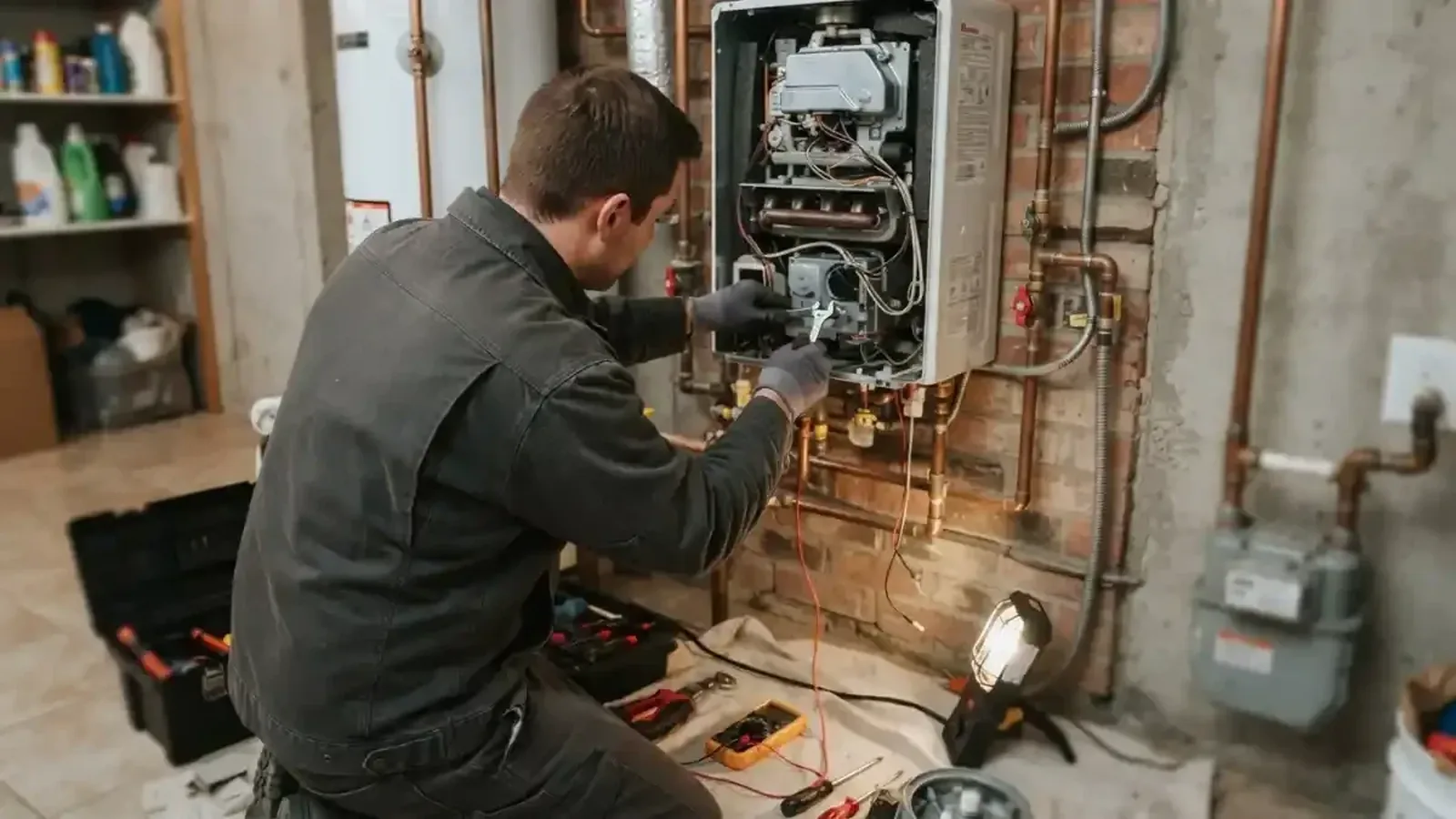
Safety before anything else
A gas smell, a soot stain around the boiler, a yellow or orange flame, or a carbon monoxide alarm all mean stop. Get everyone outside, then call the utility or 911. Do not relight the pilot, reset the unit repeatedly or open the burner cabinet yourself.
Water on the floor around the boiler is a separate worry. Switch off the boiler at its emergency switch if you can reach it without stepping in water, then close the supply valve and call.
Problems that need a specialist
| What you notice | Likely cause | What a technician checks |
|---|---|---|
| No heat, boiler will not fire | Failed ignition, tripped safety or low water | Ignition parts, safeties and water level |
| Radiators cold at the top | Trapped air | Bleed valves and system pressure |
| Banging, kettling or gurgling | Scale buildup, air or circulation trouble | Pump, flow and heat exchanger condition |
| Water pooling under the boiler | Leaking valve, fitting or heat exchanger | Source of the leak and pressure relief valve |
| Boiler cycles on and off | Wrong pressure, a bad thermostat or an oversized system | Controls, pressure and thermostat wiring |
| Pressure gauge outside its normal range | Expansion tank or fill valve fault | Expansion tank charge and fill valve |
The normal pressure range for your boiler is printed in its manual or on the label, so check the label rather than relying on a general number.
What a service visit looks like
A good visit starts with a conversation. What did you hear, when did it start, and what changed? Then the technician inspects the cabinet, watches the boiler go through a heating cycle and checks combustion, venting and safeties.
- Visual inspection for leaks, corrosion and scorching
- Water level and system pressure against the manufacturer's range
- Burner, ignition and flame signal
- Circulator pump, zone valves and thermostat
- Venting, flue and combustion air
- Pressure relief valve and expansion tank
Ask the specialist to point out the failed part and explain why it failed. If the answer is a worn igniter or a stuck zone valve, the repair is small. If the heat exchanger has cracked, the conversation changes, and it is fair to ask for a second look. Our boiler repair visits include that explanation.
Repair or replace
Repair is the right call when one part has failed and the rest of the system is sound. Replacement becomes reasonable when the heat exchanger leaks, when parts are no longer made, or when the boiler needs a repair every season.
Repair makes sense when
A single component has failed, the boiler heats evenly otherwise and there are no signs of heat exchanger damage.
Replacement makes sense when
The exchanger leaks, the boiler is oversized for the house or repairs keep stacking up.
A new boiler is a significant piece of plumbing work with gas, venting and water connections. It is covered by our plumbing installation work and needs a permit, so ask the Village before you buy.
Boilers and Woodridge homes
Census-based estimates put the median Woodridge home at 1980. About 47 percent of homes were built between 1970 and 1989, and another 22 percent between 1940 and 1969. In houses that old, a boiler may be original or may have replaced an earlier one, and the piping, radiators and valves around it are often just as old. Ask the technician to check the whole loop, not only the boiler.
Chicago O'Hare, the nearest published weather station, has an average January low near 19 degrees Fahrenheit. That is the time when a failed boiler becomes a frozen pipe problem. If your boiler stops in cold weather, open cabinet doors on exterior walls and keep faucets from freezing while you wait for a visit.
The Village lists plumbing work as permit-required, and plumbing contractors must hold a state license. Look up any technician on the IDPH Plumbing Licensing page. For a replacement, ask Community Development at 630-719-4750 what your job needs.
Neighbors ask the same question. In Downers Grove, the Building Division at 630-434-5515 handles plumbing inspections, and in Naperville building permits go through the city at 630-420-6100, option 2. Ask your own town, not the one your technician works from.
How to choose a specialist
Pick someone who asks about the make, model and age of the boiler before arriving, who will name a clear price before work starts, and who is willing to say that a repair is not worth doing. Ask about licensing, and read your warranty, because some parts and labor are covered by the maker.
Need a plumber while you read?
Our line is open around the clock, and dispatch can book a visit for the same day when a technician is free.
Questions we hear
They diagnose and repair the boiler, its controls, pump, valves and piping. A good one explains the failed part before replacing it.
Trapped air is the usual cause. Bleeding the radiators or the system can restore heat. If cold spots remain, the circulation needs a look.
A small drip can be minor, but water around the cabinet can damage controls and wiring. Shut the boiler off at its switch and call.
Check before you start. Replacing a unit involves plumbing and gas work, and the Village lists plumbing work as permit work. Ask Community Development at 630-719-4750.
Use the Plumbing License Verification tool from the Illinois Department of Public Health. The Village asks plumbing contractors for a copy of their license.
Yes. The line is open 24/7 and same-day appointments are available when a technician is free. Tell us what the boiler is doing when you call.
If the boiler is leaking or will not fire, our boiler repair team can find the fault.